Bottlenecks as Diagnostic: How to Read Where Your Team's Skill Gaps Actually Are
When AI accelerates your team, bottlenecks don't disappear—they migrate. Where they surface reveals exactly what your organization doesn't yet know how to do. Here's how to read the signal and fix the gap.
Product leader & founder, Product Manager Hub
Writes on product strategy, AI decision quality, and PM leadership—grounded in real operating experience, not generic AI takes.
Key takeaways
- Bottleneck location is diagnostic. Where your queue backs up reveals which skill, process, or judgment gap exists. Not where you think you're weak—where you actually are.
- Most bottlenecks are not capacity problems. They're validation discipline, decision-making speed, or infrastructure capability. Hiring doesn't fix those. Building does.
- The audit is quick. Measure (week 1), diagnose (week 2), build a 90-day response (weeks 2–3), track weekly. You can identify and address a skill gap in less than a month if you move intentionally.
- Your team archetype matters. High-performing teams need you to name the bottleneck; they'll fix it. Chaotic teams need clarity on why you validate before they can improve validation speed.
the bottleneck always moves
When production velocity spikes, traditional constraints evaporate. Code review used to take time—now it's done in hours. Design iteration used to be expensive—now you can explore 10 directions in a day. Writing summaries used to require human labor—now your PM can generate them at scale.
The rework cost drops to nearly zero. So the production ceiling jumps.
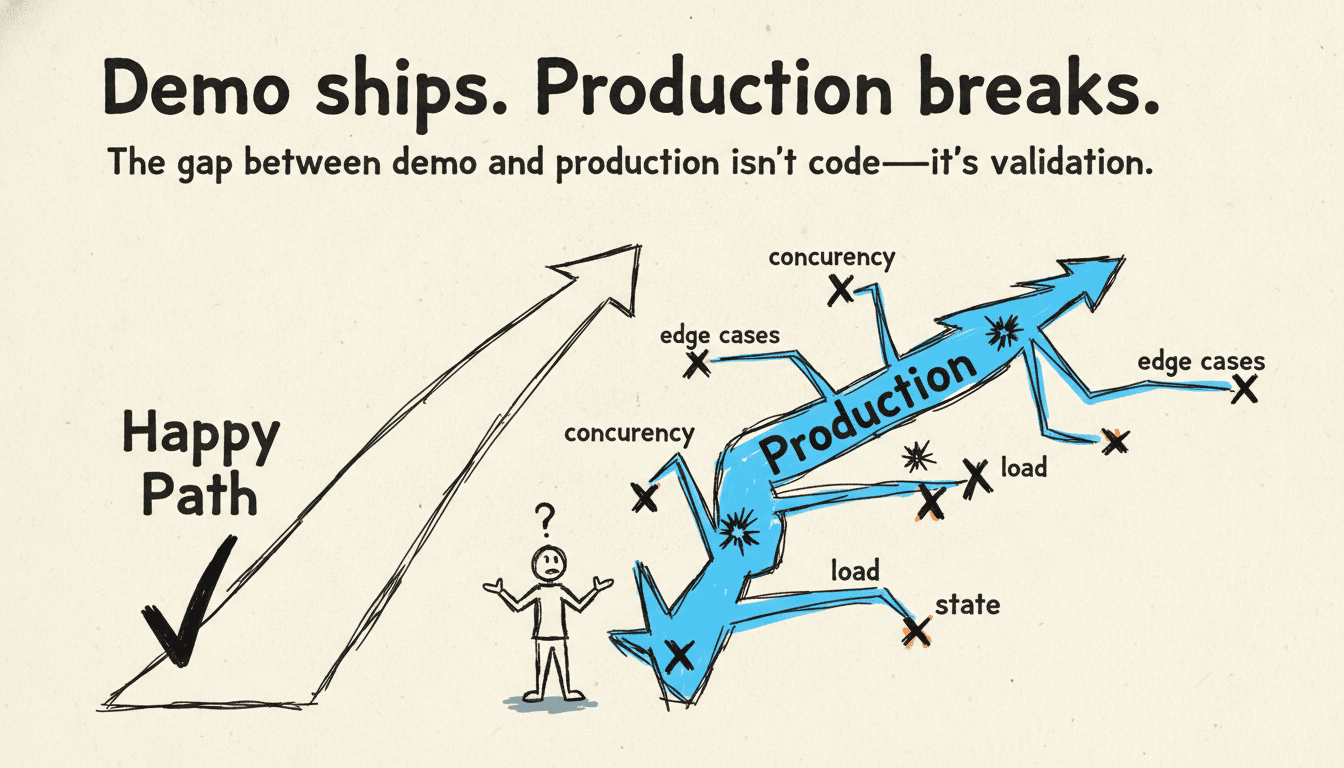
But validation capacity doesn't scale the same way.
When UX can make three design options in the time it used to take to make one, your PM can't validate all three at the same velocity. When engineers can ship code three times faster, your review process either slows down or becomes sloppy. When PMs can aggregate ten data sources in the time it used to take to get one, leadership can't consume it fast enough to make decisions.
The constraint moves upstream. It moves from production to judgment.
And here's the thing most teams miss: This isn't a scaling problem. It's a skill problem. You can't hire your way out of it because the bottleneck isn't capacity. It's clarity, discipline, and decision-making speed.
Teams that had tight code review disciplines before AI adoption? Their review queues absorb the volume because they have clear standards and fast reviewers. Teams with vague review practices see their queues explode. The velocity gain is the same. The response is completely different. That's a skill gap manifesting.
Visual break
The bottleneck migrates upstream
where the bottleneck lands tells you what's weak
There are three places your bottleneck can surface after AI adoption accelerates your team. Each one is diagnostic.
The validation bottleneck. Your review queue is exploding. Design validation slowing down. Copy review backing up. Code review cycle time extending. What this reveals: Your team can produce artifacts fast, but you can't judge them fast. That's not a capacity problem. That's a validation discipline problem.
Maybe your design review process lacks clear criteria. Maybe your code review standards are vague ("looks good to me" is not a standard). Maybe the handoff between UX and PM isn't defined, so neither knows what they're responsible for validating. The bottleneck is showing you: You need faster judgment, not faster reviewers.
The decision bottleneck. Your team can ship faster than your leadership can make calls. You've got three options ready, but it takes a week to get a decision on which one to build. Your stakeholders are seeing designs but taking weeks to approve. Your velocity feels flat even though your execution is sharp. What this reveals: Your decision-making framework is loose or too slow for the cadence your team is now operating at.
This is the hardest one to fix because it usually means your leadership team needs to clarify how they actually decide, and which decisions are reversible (move fast) vs. irreversible (slow down). This is a judgment architecture problem, not a capacity problem.
The infrastructure bottleneck. Your systems can't keep pace. Onboarding new engineers is taking 4+ weeks. Your CI/CD pipeline is slow. Your test suite takes forever to run. Your deployment process is manual. You've got code sitting around waiting to ship because the deployment process is clogged. What this reveals: Your systems are fragile or poorly automated.
When you're shipping 2x the volume, fragile infrastructure becomes a serious constraint. You need systematic capability, not headcount.
The move is this: Don't guess where your bottleneck is. Measure it. Where is the queue actually deepest? Where is the cycle time actually longest? That's the signal. That's your first skill gap.
read your bottleneck, then build the response
Once you know where your bottleneck is, the fix is straightforward—but it's not what most teams do.
If your bottleneck is validation: Don't hire faster reviewers. Implement clear review criteria. Build automation where you can (linting, type checking, automated testing). Create review gates that let the team move fast on low-risk changes and slow down on high-risk ones. Give reviewers a clear mental model of what they're looking for. The goal: judgment speed, not capacity.
If your bottleneck is decision-making: Don't add more meeting time. Clarify your decision framework. Which decisions are reversible (move fast, decide with 70% information, learn from shipping)? Which are irreversible (slow down, get it right the first time)? Once your team knows the difference, decisions move much faster because people aren't over-consulting on things that don't matter and under-consulting on things that do.
If your bottleneck is infrastructure: Don't hire more DevOps. Audit your systems. Measure onboarding time. Measure CI/CD cycle time. Measure test coverage and test run duration. Find the longest pole in your tent and fix it. Usually it's one of: slow test suite, manual deployment, weak automation, fragile deployment pipeline. Fix that first, measure improvement, move to the next one.
Annnnnd here's the part most teams don't fully reckon with: All three fixes require discipline and process changes, not headcount. You can't hire your way to faster judgment. You can't hire your way to a clearer decision framework. You can't hire your way to better infrastructure. You have to build these capabilities.
how to audit systematically (and move fast)
You can identify and begin addressing your skill gaps in 2–3 weeks if you move intentionally. Here's the cadence:
Week 1: Measure your bottleneck.
Identify the queue that's deepest. If it's code review, measure: review request to first review (speed), number of open PRs, review cycle time. If it's design validation, measure: design completion to approval, number of waiting-for-feedback designs. If it's decisions, measure: decision-request-to-decision time. If it's infrastructure, measure: new engineer onboarding time, CI/CD cycle time, deployment frequency.
Pick the one metric that feels most broken. That's your bottleneck.
Week 2: Map it to the skill gap.
Ask your team: "What's slowing us down?" Don't assume the answer. Listen for patterns. Is it unclear standards? Unclear ownership? Slow reviewers? Clogged infrastructure? Weak automation? Document what you hear. That's your diagnosis.
Week 2–3: Build a 90-day response.
Don't hire. Don't add meetings. Implement the process, automation, or clarity that matches your bottleneck. Assign an owner (someone with authority to change how the team works). Define success (what does the metric look like when this is fixed?). Commit to weekly reviews.
Weekly: Track progress.
Is the queue shrinking? Is cycle time improving? Are people less frustrated? Measure weekly, not monthly. If progress stalls, adjust the intervention.
The whole move takes three weeks to diagnose and three months to see real improvement. But it works because you're fixing the actual gap, not working around it.
the harder question: team archetype matters
Here's something that gets overlooked: The same bottleneck can appear in two different organizations and require completely different fixes.
A high-performing, self-directed team that hits a validation bottleneck will usually recognize the problem and start implementing solutions on their own. They'll add code review standards, create design criteria, clarify decision frameworks. They just needed you to name the problem.
A chaotic, low-trust team hits the same bottleneck and something different happens: The bottleneck gets worse. People start shipping without validation. Quality degrades. Trust erodes further. The team moves slower, not faster, because AI amplified their existing dysfunction.
The diagnostic: Ask your team "What are we validating for, and who decides?" If they can't answer that clearly, your bottleneck isn't the first problem you need to fix. The first problem is clarity and shared mental models. Bottleneck fixes come after that foundation is there.
This is where AI Adoption Team Archetype Response matters. High performers accelerate. Chaotic teams become more chaotic. The skill gap your bottleneck reveals is always real—but the urgency of fixing it depends on your team's baseline capability.
closing question
When AI accelerated your team, what bottleneck surfaced first? And more importantly: Is that bottleneck revealing a process gap, a skill gap, or something deeper in how your team actually works together?
Because that answer changes everything about how you respond.
Good luck friends.
If this was useful
Share the essay, or follow along where I post the shorter takes.
Go deeper
If this maps to a stall you're in—demo that won't ship, vibe-code without a product, or a team that can't take it—join Access for playbooks and community.