Building the Moat They Can't Copy: Why Speed Is Swallowing Your Startup
Speed and feature parity are the trap. The moat moves toward embedded domain knowledge and workflow depth before foundation models commodify the gap.
Product leader & founder, Product Manager Hub
Writes on product strategy, AI decision quality, and PM leadership—grounded in real operating experience, not generic AI takes.
Key takeaways
- A grounded take on building the moat they can't copy: why speed is swallowing your startup.
- Structured for product leaders making AI and strategy calls under real constraints.
- Read the full essay for frameworks, tradeoffs, and practical next steps.
the race you're losing (and not because you're slow)
There's a blocker red flag in the library called "Competing on Model Capability Instead of Knowledge Position." It exists because the graveyard of AI startups is full of teams that tried to compete on velocity.
Here's what actually happens: OpenAI releases GPT-5. Anthropic releases Claude Next. Google releases something. Within weeks, every feature you built on top of the previous generation gets obsolete. Not because you were slow. But because the foundation underneath you shifted.
Model improvements compound automatically across the entire application layer. Every startup building on OpenAI's models wakes up to the same new capability. The features you spent three months building become table stakes overnight. And the ones you spent three months planning become impossible to ship before they're irrelevant.
The speed trap is seductive because it feels like defensibility. You ship something. Users love it. You measure velocity and call it progress. What you're measuring is your rate of becoming replaceable.
Annnnnd here's the part most teams don't fully reckon with: the foundation model companies don't need to out-execute you. They just need to wait. Their improvements will make your differentiation disappear automatically. You're competing in a race where the finish line is moving faster than you can run.
So the question becomes: if speed isn't the moat, what is?
the stack nobody drew on the whiteboard
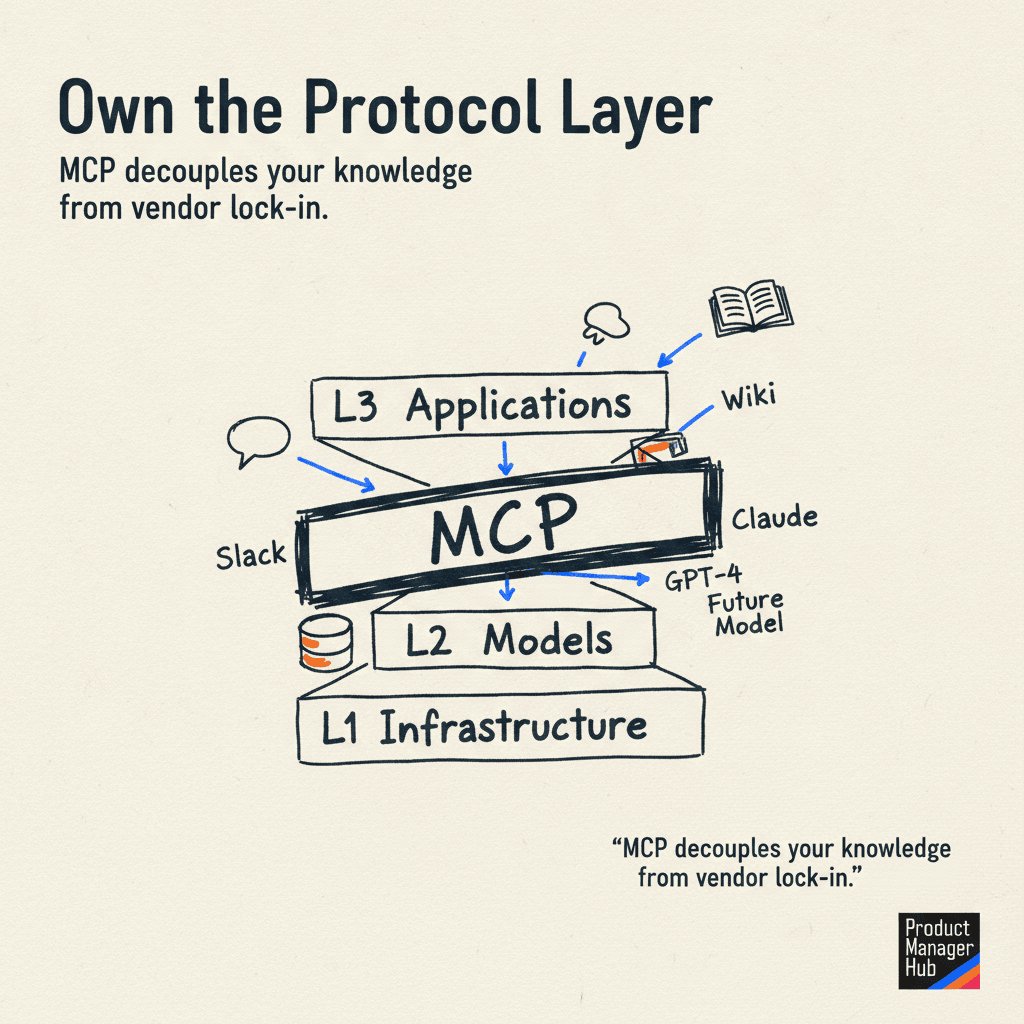
There's a framework in the library called AI Stack Layer Strategy. It names three layers in the AI product stack: the foundation models themselves (OpenAI, Anthropic, Google), the infrastructure underneath them, and the applications built on top.
Most application-layer companies—that's you—assume they're competing against the foundation model companies. That's the frame that leads to the speed trap. If you're competing against OpenAI, then yes, faster is better. You lose. The end.
But you're not competing against them. You're building on top of them.
There are three coherent strategies available when you're building on top of foundation models:
The first: Ship integrations and breadth. Add every connector, every workflow, every possible place a user might want to use the model. This is velocity as a strategy. It's also the fastest way to become irrelevant, because the model companies can add these integrations to their own products faster than you can, and their distribution is better.
The second: Build for a specific persona. Pick one user type—lawyers, radiologists, product managers—and go deeper on their workflow. This is better than breadth, but it's fragile. The moment OpenAI or Anthropic ships a lawyer-specific interface or a radiology-specific tool, your persona moat evaporates.
The third: Embed domain knowledge deep enough that your product becomes indispensable to a specific outcome, not just a persona. This is where the defensibility actually lives.
The difference between the second and third is subtle and operational. It's the difference between "building for lawyers" and "encoding legal domain expertise into your workflows and data layers so deeply that the model becomes more useful in your product for that specific work than it would be anywhere else."
The first strategy gets you acquired or killed. The second gets you flattened by a foundation model company announcement. The third is the only play that survives.
the window is real, and it's closing
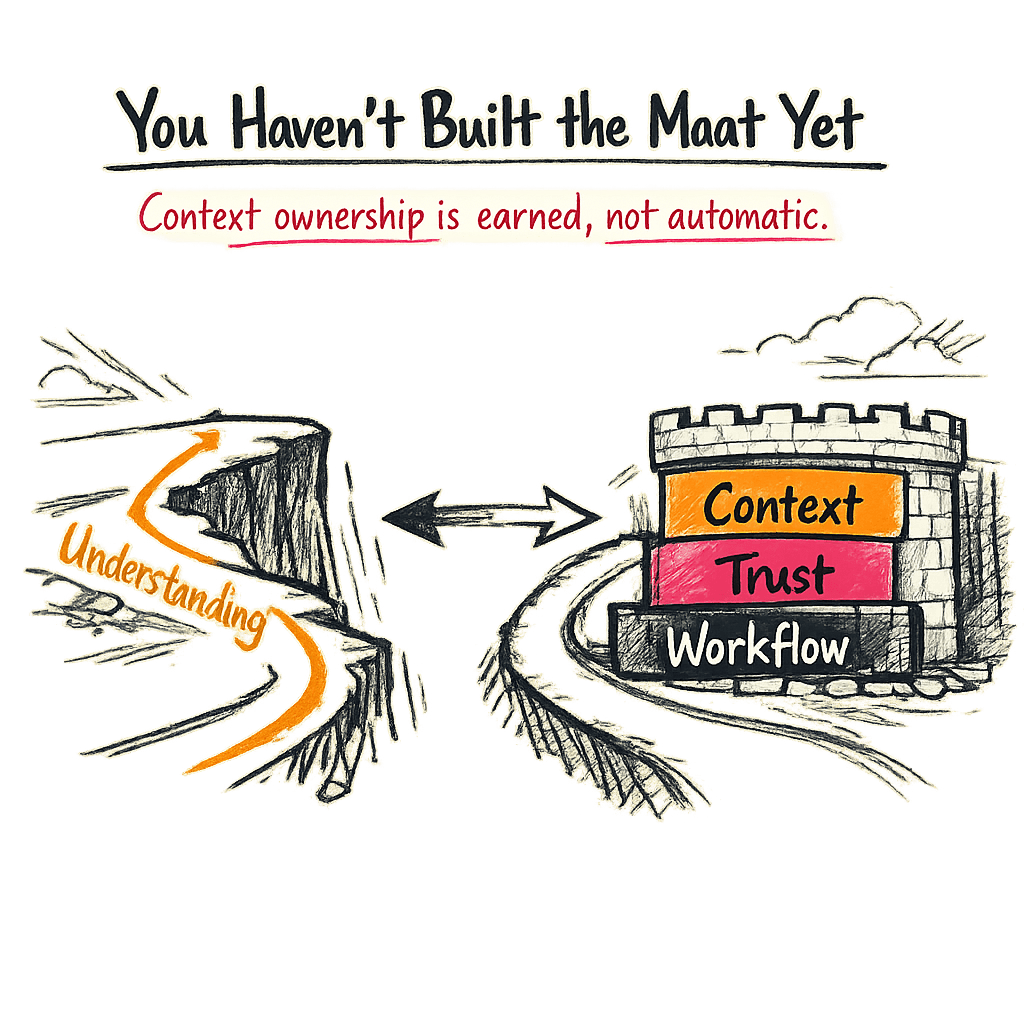
There's a framework that names this: Domain Knowledge Moat in AI Era. It describes a finite window—the period where domain expertise creates asymmetric advantage before general intelligence improves enough to close the gap.
That window exists right now. And it's narrowing.
Here's what's happening at the edge: the foundation models are improving fast enough that general domain knowledge (what any lawyer or radiologist or product manager knows) will eventually be baked into the model itself. The stuff that's sitting in your training data today will be common capability in Claude 5. The workflows you encoded last year will be assumptions in next year's model.
The teams that win in this window are the ones finishing one workflow completely on their best dataset before that happens. Not expanding breadth across ten use cases. Not chasing every integration that lands in the feature request backlog. Finishing one thing so deeply that it stays defensible after the model improves.
This is the opposite of the speed instinct. It's the opposite of velocity as a metric. It's asking: "What would our product look like if we spent the next eighteen months making one workflow so good that a user couldn't replicate it with the raw model alone?" Then building that. Then defending it. Then moving to the next one.
The moat moves from speed to depth. From breadth to specificity. From visible features to invisible context.
what the right fight actually is
There's a red flag called "Single-Budget Framing for Multi-Value AI Tools." It describes teams that have built something genuinely useful but frame it as a single feature instead of a defensibility play. They get treated as a cost center instead of a moat. The roadmap gets deprioritized. The investment dries up.
The real fight isn't between you and OpenAI. It's between the structural knowledge embedded in your product and the incidental knowledge sitting in Slack.
Structural knowledge is what lives in your data layer, your workflows, your model-accessible assets. It's baked in. A user can't extract it and use it somewhere else, because it's embedded in how your product works. When the model improves, this knowledge becomes more valuable, not less, because the model can do more with it.
Incidental knowledge is what's just sitting there. It's institutional memory. It's expertise that lives in people's heads or in unstructured messages. It's defensible only as long as you keep it secret. The moment OpenAI or Anthropic figures out how to extract it, it's gone.
The right fight is converting as much of your domain knowledge as possible from incidental to structural before that happens. It's unsexy. It's not a feature. It doesn't ship in a demo. It doesn't look like progress on a roadmap.
It's the entire game.
Annnnnd here's where most teams go wrong: they measure success as "visible AI progress." Launch announcements. New capabilities. Features that appear in release notes. What they should be measuring is indispensability: How much would my user's outcome suffer if they had to use the raw model alone?
If the answer is "not much," then you're a feature. If the answer is "everything," then you're a position.
the structural audit
This is the operational part. This is where the frame becomes a decision.
Sit down with your product, your data, your workflows. Ask yourself three questions:
First: What knowledge is actually embedded in your product? Not what you think is embedded. What's actually there. Walk through your code. Walk through your training process. Walk through how a user gets a result. Where does your domain expertise show up? Where is it actually making a difference?
Second: What knowledge is just sitting in your Slack, your documentation, your team members' heads? This is the incidental knowledge. The stuff that makes your team valuable but doesn't show up in the product. The institutional patterns, the decision trees, the subtle judgments that shouldn't require a human in the loop but currently do.
Third: What's on your roadmap that makes sense only if you're competing on speed? Count the hours. Count the sprints. Estimate the capacity. How much of your engineering roadmap is allocated to visible features vs. knowledge embedding? If it's 80/20 in favor of features, you're building for the wrong fight.
Then ask the hard question: If we stopped shipping visible AI features for the next two quarters and spent that capacity converting incidental knowledge into structural knowledge, what would disappear from our product? And what would become irreplaceable?
The answer to that question is your strategy.
closing: the real competition
You're not competing with OpenAI. You're not competing with Anthropic. You're not competing with Google's foundation models or whatever comes next.
You're competing on whether the knowledge that makes your domain expertise defensible stays embedded in your product before the foundation models improve enough to commodify it. You're competing against time. The window is real. It closes.
The startups that survive this cycle aren't the fastest. They're the ones that asked the right question early enough: not "how do we ship faster," but "what do we know that they don't, and how do we bake it into the product so deeply that it survives the next model release?"
Speed was never the moat. It was the distraction.
Are you building a feature, or are you building a position? And if it's the former, do you know when you'll have to start over?
Good luck friends.
If this was useful
Share the essay, or follow along where I post the shorter takes.
Go deeper
If this maps to a stall you're in—demo that won't ship, vibe-code without a product, or a team that can't take it—join Access for playbooks and community.