MCP for Product Managers: The Hidden Leverage Point in Your AI Architecture
MCP isn't a technical detail—it's a strategic decision about whether your AI product can evolve independently of your model vendor. Here's how to think about it.
Product leader & founder, Product Manager Hub
Writes on product strategy, AI decision quality, and PM leadership—grounded in real operating experience, not generic AI takes.
Key takeaways
- A grounded take on mcp for product managers: the hidden leverage point in your ai architecture.
- Structured for product leaders making AI and strategy calls under real constraints.
- Read the full essay for frameworks, tradeoffs, and practical next steps.
what MCP actually is (not what your engineers told you)
MCP is a protocol—a standard for connecting AI models to external tools, data sources, and knowledge bases. If you've heard of RAG (Retrieval-Augmented Generation), you might think MCP is the same thing. It's not.
RAG is a tactic for retrieval. MCP is the interface layer that survives retrieval tactics, data source changes, and even model swaps.
Here's the operational reality most teams face: Your AI features today are tangled directly into your data layer. Your agent calls your database. Your chatbot queries your vector store. Your model integration points are wired to your current architecture like cables you can't safely unplug.
When you want to—
- Upgrade to a new model
- Add a new data source
- Let customers build their own AI agents on top of your system
- Run the model off-device or via a different vendor
...you're doing major rewrites. Every integration point has to be retouched. Every context flow has to be re-architected. By the time you finish, you've burned months and the model landscape has shifted again.
MCP prevents this.
It decouples your domain knowledge and external context from your model integration. Instead of your model pulling context directly from your database, it asks for context through a standardized protocol. That protocol can route to a database, a file system, a customer's Slack, an internal wiki, or anything else. The model doesn't care. Your application logic doesn't care. Only the protocol matters.
This is not an academic distinction. It's the difference between "we can try a new model next quarter" and "we'd have to rewrite everything to try a new model next quarter."
the PM decision hidden inside MCP
Most PMs don't realize they're making an MCP choice. But you are, whether you name it or not.
There are three options:
Option 1: You build MCP servers as the standard. You formalize your domain knowledge, data access patterns, and context flows as published MCP servers. Your customers—and your own internal teams—integrate via MCP. You own the protocol. When you want to upgrade your model, add a data source, or let customers extend your system, you can do it without breaking existing integrations.
Option 2: You let customers and internal teams integrate directly into your LLM instance, your vector database, or your current data layer. You own the integration tightly. But you lose the flexibility. Every upgrade, every architectural change, breaks their workflows. You're bound to your current choices.
Option 3: You ignore this entirely. You don't formalize any of it. Everything stays tangled. The cost is zero today. The bill comes due in 6 quarters when you want to change something fundamental.
This is the choice we made with the PMHub MCP server. Instead of building a chatbot that only works inside our own interface—"ask the PMHub bot your question, get an answer"—we published the framework library and red flag database as an MCP server. That means it plugs into Claude Desktop. It works in Cursor. It integrates into whatever tool a product manager is already using. The protocol is the product surface.
That conversion—from "proprietary feature locked to our interface" to "open protocol that lives in the customer's environment"—is what Option 1 actually looks like. It's not a technical detail. It's a positioning choice. It says: "You can build on top of this knowledge without being dependent on us."
According to AI Stack Layer Strategy, this is a Level 2–Level 3 bridge decision. Level 1 is infrastructure (compute, cloud). Level 2 is the models themselves (Claude, GPT-4, Gemini). Level 3 is the applications built on top. MCP is where you decide whether you own the bridge between L2 and L3, or whether you let someone else control it.
Option 1 means you own the bridge.
the defensibility angle (where moat-building happens)
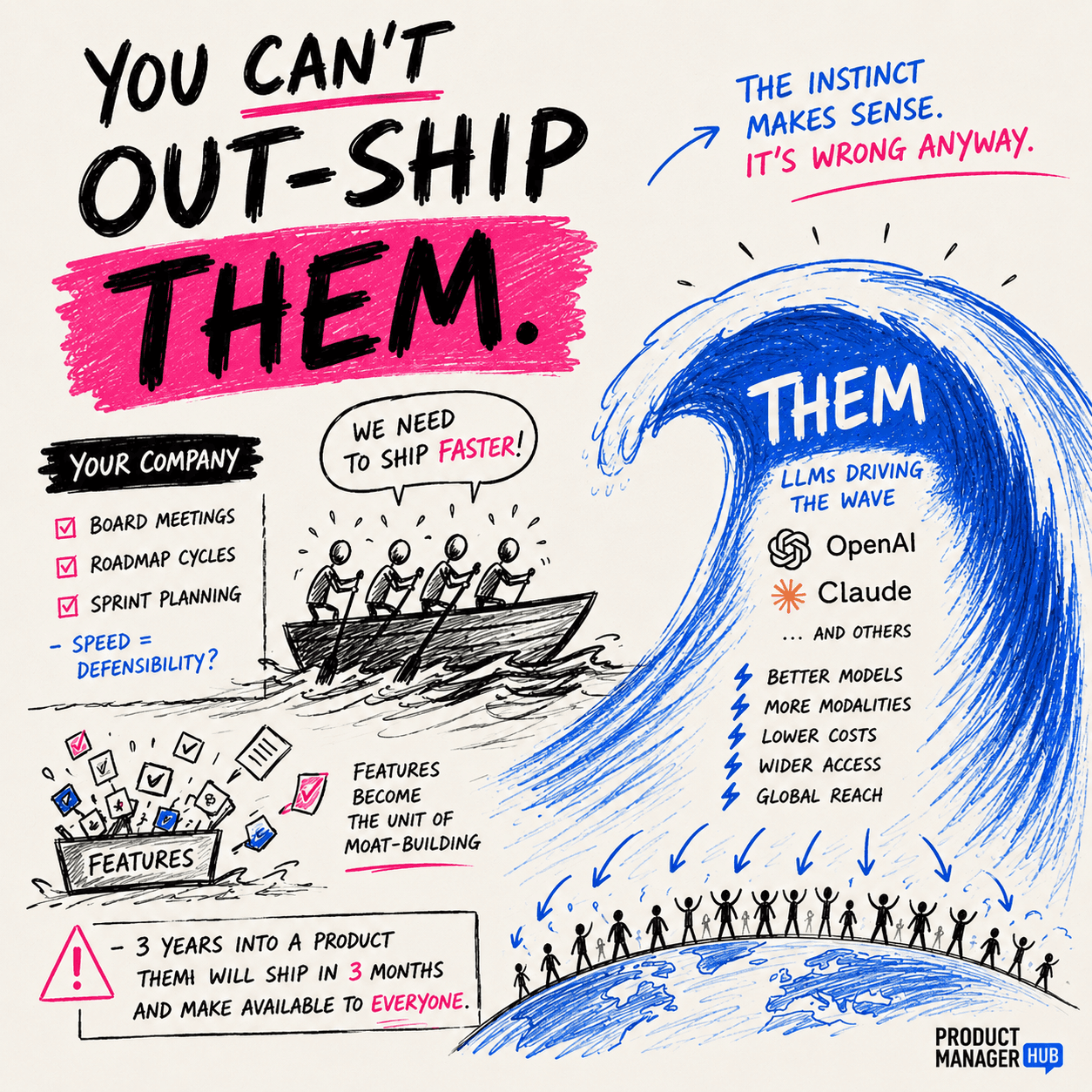
Here's the part most teams don't fully reckon with: General models improve exponentially. Your domain knowledge does not.
Claude gets better every quarter. GPT-4 gets better. In a year, the capabilities gap between today's models and next year's models will be enormous. But your knowledge about how your customers actually work—their workflows, their constraints, their decision patterns—stays relatively stable. It doesn't improve because models improve. It improves because you learn more about your customers.
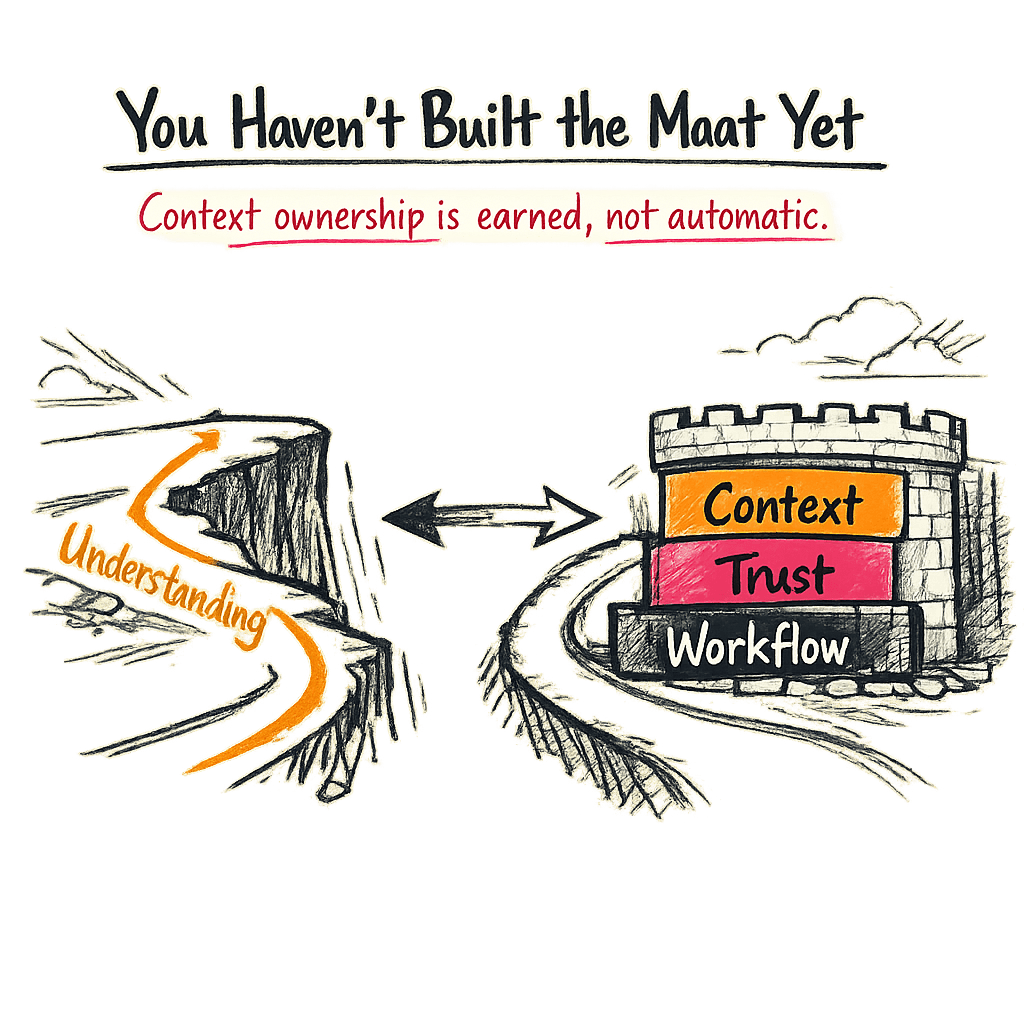
That's the asset. That's what's defensible. Same argument as building a moat they can't copy: the knowledge stays yours when the model layer moves.
MCP + domain knowledge = structural moat. Here's why: When Claude-Next or GPT-5 or whatever the dominant model is three years from now—when that model is available and you want to upgrade to it—you can. You pull the lever. Your internal MCPs route to the new model. Your customers' integrations route to the new model. Nothing breaks. Your domain knowledge, formalized as MCP servers, stays portable across model changes.
The team that didn't build MCPs? They're tangled. Their knowledge is embedded in vector store configurations, prompt templates, and database query logic wired directly to their current model. Upgrading means refactoring all of that. It's months of work. It's expensive. It's risky.
Domain Knowledge Moat in AI Era describes this framework. MCP is the implementation choice that actually lets you execute it. You're not competing on model quality—you can't. You're competing on the specificity of your knowledge and your ability to evolve that knowledge independently of the underlying model.
the deployment choice (internal vs. customer-facing MCPs)
There are two very different plays, and they happen in sequence.
Internal MCP servers are MCPs your own teams use. Your engineers, your agents, your internal tools. Instead of each AI feature building its own integration with your data layer, they all talk through the same MCP protocol. The pattern is standardized. The context flows are documented. New engineers can compose new AI features faster because they're not rebuilding the integration layer every time. Reference Agent Loop Architecture—MCP is how you actually scale agent systems without creating a unique integration for every agent.
The measure here is operational leverage: engineering velocity, time to ship features, context debt reduction, engineer onboarding time. If you build internal MCPs well, all of these improve.
Customer-facing MCP servers are MCPs you publish so customers and partners can build on top of your system without lock-in. This is positioning. It says: "You can extend this without needing us." But it only works after you've built real trust and proven real value.
According to AI Feature Sequencing, customer-facing MCPs don't ship in Phase 1 (proof of concept) or early Phase 2 (market validation). They ship in Phase 2-3, after your core product is sticky and your AI value is obvious. If you expose MCPs too early—before customers believe in your product, before they've experienced the value—they'll integrate, hit problems, and churn. You'll have added complexity without adding trust.
The deployment sequence matters. Start internal. Prove it works. Measure the impact. Then go external.
what goes wrong (red flags in MCP deployment)
Exposing Private MCP Servers to Public Internet. Many teams accidentally expose internal MCPs as part of infrastructure deployment without proper authentication, rate limiting, or perimeter controls. The context flowing through those servers might be customer data, proprietary knowledge, or both. A public internal MCP is a data leak waiting to happen. You need security gates and access controls before any of this goes live.
Building Without Clarity on Context Ownership. Who owns the data flowing through your MCP? Is it your proprietary knowledge? Customer data? Both? If this isn't clear, you'll end up with security debt, compliance debt, and escalation debt. Answer this question before you build, not after.
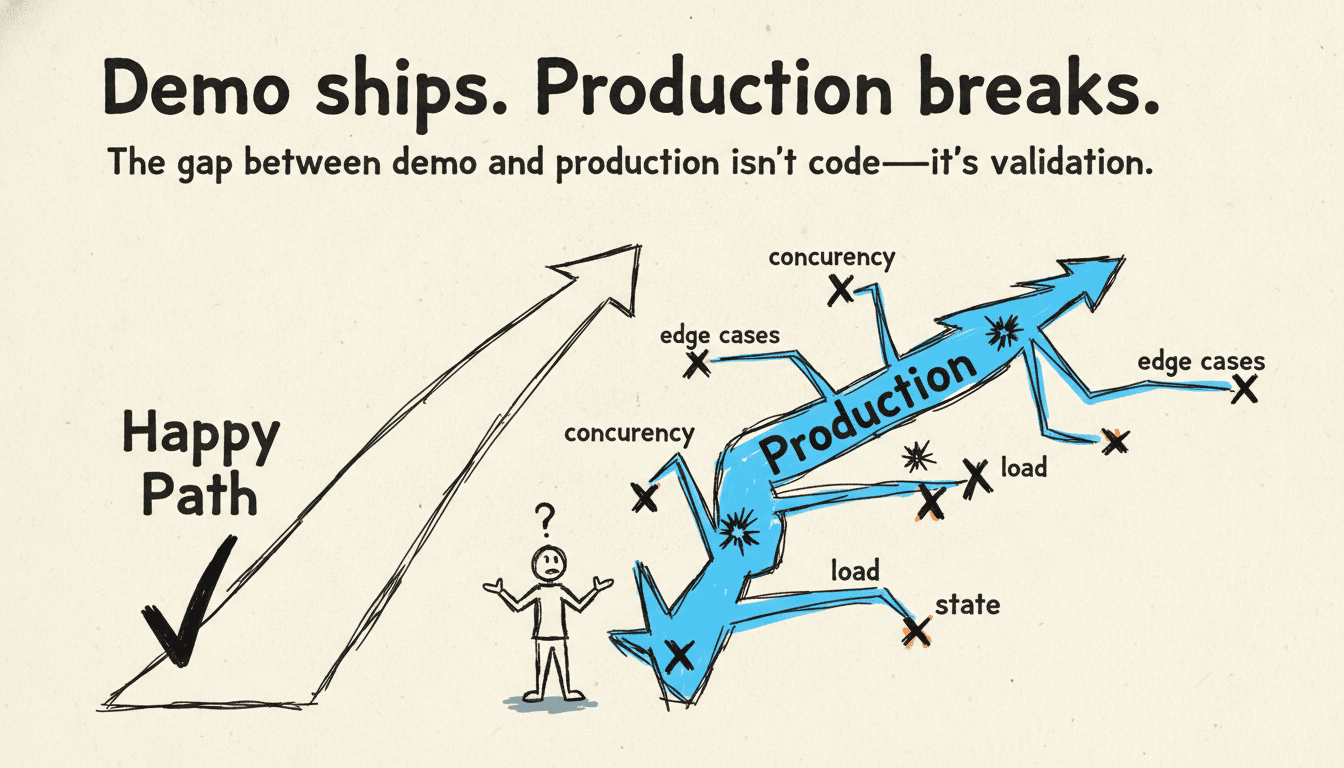
Deploying MCP to Customers Before Proving Internal Value. Customers will misuse MCPs in creative ways. They'll hit edge cases you didn't anticipate. Your first external deployment will be messy. You need 2–3 quarters of internal iteration and learning before you're ready to hand this to customers. Don't skip this phase or you'll burn trust.
Building Without Technology Readiness Gate. MCP is infrastructure-first. It's not a feature. It's the scaffolding underneath features. If your team isn't ready to maintain MCP infrastructure, debug MCP integrations, and update MCP servers on a regular cadence, don't build it yet. Wait until you have the operational maturity.
Embedding AI Before Core Product Adoption Proven. The temptation is to build MCPs and immediately start using them in user-facing AI features. Resist this. Your core product—the thing that works without AI—needs to be solid first. AI features should layer on top of an existing customer foundation, not be the foundation. If your AI features fail and they're wired through MCPs, you're debugging three layers at once. Validate core adoption first.
the three-phase sequence for product leaders
Phase 1 — Internal adoption. Build MCP servers for your own agent loops and internal tools. Don't think about customers yet. Think about your own engineers. Can they compose new features faster? Is the integration layer cleaner? Can a new engineer onboard faster because the context patterns are standardized?
Measure: engineering velocity (features shipped per sprint), context debt (how much domain knowledge is living in ad-hoc integrations vs. documented MCPs), engineer onboarding time (how long before a new engineer can ship their first feature).
Phase 2 — Operational leverage. You've proven that internal MCPs work. Now use them to ship new features faster. Build AI features that rely on the MCP infrastructure. This is where the speed advantage shows up. Features that would have taken 2 weeks of integration work now take 3 days because the context layer is standardized.
Measure: time from feature concept to shipped, features per sprint, engineer satisfaction (are they happier with the cleaner architecture?).
Phase 3 — Customer-facing MCPs. Only after core product adoption is solid and your internal teams are shipping fast through MCPs, expose them to customers. Let customers build their own agents on top of your system. This is the positioning move. You're no longer just a tool—you're a platform.
Risk: Don't do this if core adoption isn't proven. AI features wired through MCPs are powerful, but they're also new and unfamiliar. You need a solid foundation underneath.
the closing question
Most product managers think of MCP as something the engineering team handles. It's infrastructure. It's not a product decision.
It is.
MCP is the decision about whether your AI product can evolve independently of your model vendor and your current data layer, or whether you're locking yourself into today's architecture until change becomes impossibly expensive.
Which are you building: a feature locked to today's models and integrations? Or an extensible system that can absorb new models, new data sources, and new capabilities over the next 3 years?
And if you're building the latter—if you're making the MCP choice—are you doing it now, when the cost of refactoring is lowest? Or later, when context debt has made every change painful and expensive?
We built PMHub this way for exactly this reason—happy to show you what that looks like in practice. Check out the MCP server and see how it works.
Good luck, friends.
If this was useful
Share the essay, or follow along where I post the shorter takes.
Go deeper
If this maps to a stall you're in—demo that won't ship, vibe-code without a product, or a team that can't take it—join Access for playbooks and community.